High-tech drone countermeasures used in the modern militaryHigh-tech drone countermeasures
used in the modern militaryHigh-tech drone countermeasures used in the modern military
Unmanned Aerial Vehicle (UAS) systems have rapidly transformed the modern battlefield. Today, small drones can perform not only reconnaissance, surveillance, target location, and electronic missions, but also transport tasks and even carry destructive payloads. The relatively low cost and increasing autonomy of drones present a growing challenge for military forces: how to detect and intercept drones without incurring costs far exceeding those of the attacker?
High-tech drone countermeasures used in modern military applications are becoming an essential component of modern air defense systems. Modern counter-drone or anti-drone systems (C-UAS) are no longer limited to traditional radio jamming equipment. A mature C-UAS architecture can integrate radar, radio frequency (RF) detection, electro-optical/infrared cameras, acoustic detection, artificial intelligence, electronic warfare, directed energy weapons, and kinetic interceptors. Its core objective is to establish a layered defense system capable of detecting, tracking, identifying, and neutralizing drones.

1. Unmanned Aerial Vehicle (UAV) Detection Radar
Radar is one of the most important technologies in modern military counter-UAV systems. Unlike traditional manual observation, radar can continuously monitor the airspace and provide information such as the target's position, speed, and trajectory. Dedicated counter-UAV radars are optimized for small, low-speed targets and can detect small UAVs that traditional air defense radars may not easily identify. Modern systems can use either active radar or a combination of active and passive radar. The advantages of radar include longer detection range, all-weather operation, and the ability to track multiple targets simultaneously. It can also detect UAVs that do not actively emit radio frequency signals, thus compensating for the shortcomings of purely RF detection systems.
Micro-Doppler technology can analyze the characteristics generated by moving parts such as the UAV's rotor, thereby improving target classification capabilities. Dedicated micro-Doppler radar can help the system distinguish UAVs from other small moving targets such as birds.
2. Radio Frequency (RF) Detection and Electronic Intelligence
Many unmanned aerial vehicles (UAVs) rely on radio frequency (RF) signals to communicate with their controllers. RF detection systems can passively monitor the electromagnetic spectrum to detect potential UAV activity and, in some systems, further analyze the location or signal characteristics of the UAV and its controller.
A key advantage of RF detection is its passive operation; it can listen for signals without actively transmitting them. However, it also has significant limitations. For example, autonomous or RF-silent UAVs may not provide traditional control signals. Furthermore, complex electromagnetic environments and constantly evolving communication protocols can reduce the identification capabilities of RF systems. In modern military environments, RF detection is better suited as an integral part of a multi-sensor system.
3. AI-Powered Electro-Optical and Infrared Sensors
Electro-optical (EO) and infrared (IR) systems provide more intuitive visual confirmation for drone detection. High-resolution cameras help operators identify the detected target, while infrared sensors provide auxiliary detection capabilities in low-light environments. AI image recognition technology further enhances automatic classification and target identification capabilities. EO sensors provide visual information about the drone and its potential payload and can be integrated with EO/IR cameras into counter-drone command and control systems. However, cameras are susceptible to darkness, fog, weather, and obstructions, and therefore often need to be used in conjunction with radar, RF, or acoustic systems.

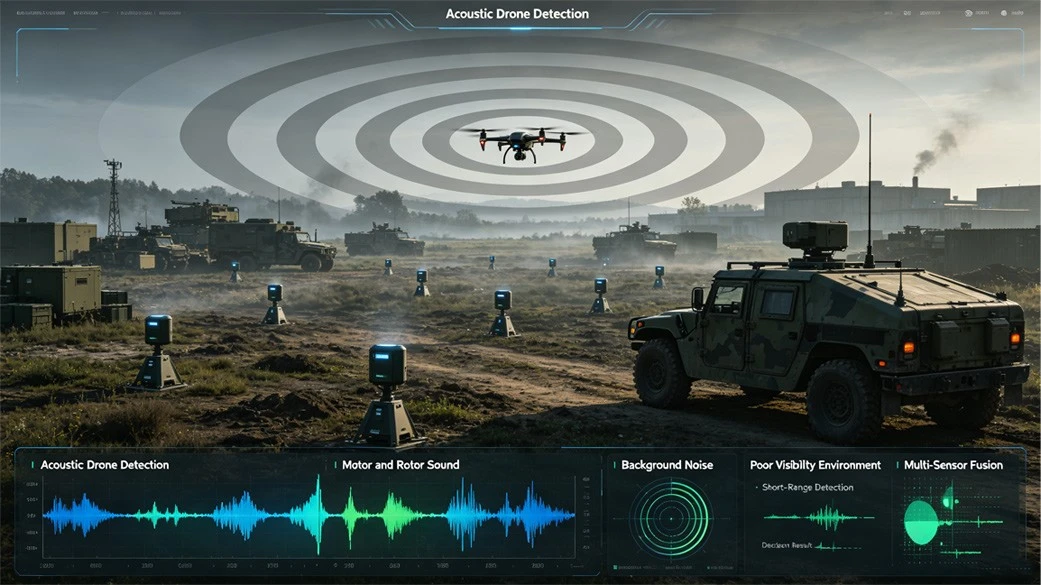
4. Acoustic Drone Detection
Acoustic sensors detect targets by identifying the sounds produced by the drone's motors and rotors. Compared to radar, acoustic systems typically have a shorter detection range, but they can serve as a valuable auxiliary sensor in environments with poor visibility.
The biggest challenge is background noise. Vehicle, engine, machinery, wind, and battlefield ambient noise can all affect identification results. Acoustic detection is best suited for multi-sensor fusion systems combined with other sensors.
5. Electronic Warfare: Radio Frequency Jamming and Deception
Electronic warfare is a widely discussed area in modern counter-drone technology.
RF jamming primarily disrupts the communication link between the drone and its controller, or affects relevant navigation signals, preventing the drone from continuing its mission according to its original control methods. Depending on the drone's design and safety procedures, communication interruption may trigger landing, return-to-home, or other preset modes.
In contrast, deception techniques do not simply suppress signals but attempt to provide the target with false information, thereby affecting the drone's navigation or communication behavior.These techniques offer non-kinetic countermeasures, but they also carry risks. Jamming can affect friendly communication systems, while the effectiveness of deception techniques depends on the specific navigation and communication architecture of the drone.
6. High-Power Microwave Weapons
High-power microwaves (HPM) represent another emerging type of directed-energy anti-drone technology. HPM systems do not directly strike drones with conventional munitions, but instead utilize high-intensity electromagnetic energy to affect their electronic and communication systems.
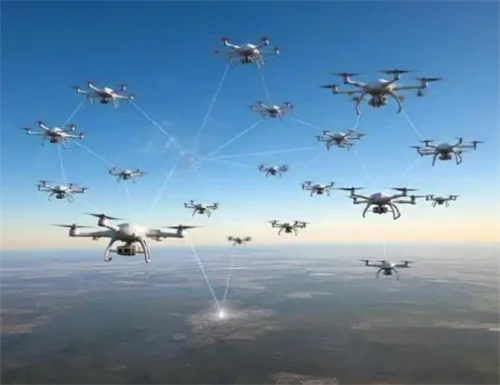
The potential advantage of this technology is its ability to affect multiple drones within a certain range, making it highly valuable for drone swarm defense. It has traditionally been applied more in the military field. HPM still faces challenges related to cost, power requirements, electromagnetic compatibility, and the impact of surrounding electronic equipment.

7. High-Energy Laser Weapons
High-energy lasers are also an important development direction in modern military anti-drone technology.
Laser weapons use highly concentrated energy to attack targets, rather than relying on conventional munitions. This means that when facing a large number of low-cost drones, lasers may offer an attractive unit interception cost.
Laser can also be used against some drones that are not easily affected by conventional electronic warfare, including certain autonomous flight platforms. Weather, atmospheric conditions, target tracking, line-of-sight, and the drone's own structure all affect the actual effectiveness of laser weapons. High-energy lasers are more suitable as part of a layered defense system rather than completely replacing traditional air defense weapons.
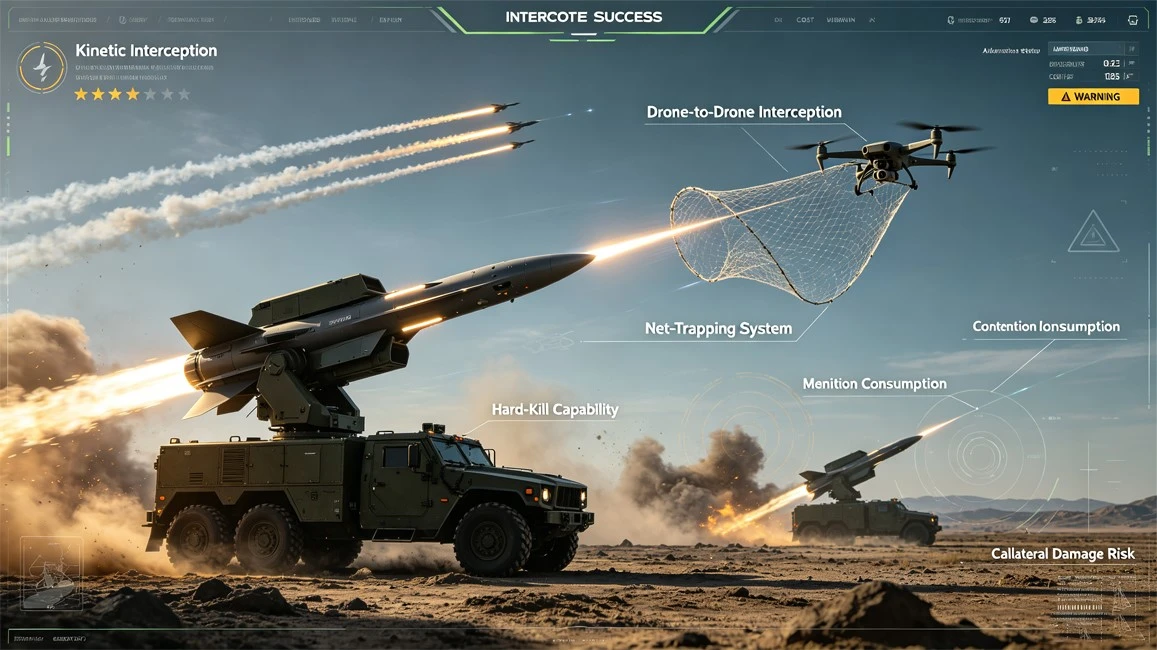
8. Kinetic Interception and Drone-to-Drone Interception
When electronic countermeasures fail to effectively address a threat, military forces may employ kinetic interception.
Related technologies include conventional interceptor munitions, dedicated anti-drone munitions, drone interceptors, and net-trapping systems. Kinetic methods can provide true "hard-kill" capability, but they also introduce issues such as munition consumption, fragmentation, collateral damage, and cost-benefit ratio. This is particularly important in battlefield environments where drones are used extensively.
9. AI, Sensor Fusion, and C-UAS Command and Control
One of the most important development trends in modern counter-drone technology is not the integration of a single weapon, but rather the system integration of multiple technologies.
Modern C-UAS platforms can aggregate data from radar, RF, electro-optical, infrared, and acoustic sensors into a unified command and control system. Through sensor fusion, the system can form a more complete airspace situation map and select appropriate countermeasures for the current threat.
Advanced C-UAS architectures can receive input from multiple sensors, fuse the data into a unified airspace situation, and further select appropriate countermeasures. The importance of scalable, sensor-independent C2 systems is also emphasized. AI and machine learning can further assist the system in target classification, anomaly detection, threat ranking, and alarm filtering. This capability is particularly important when military forces face multiple or even large numbers of drones.
10. Why Will Layered Defense Become the Future Trend?
Because drone threats are rapidly evolving; drones can be modified, perform autonomous flight missions, use different communication methods, and be deployed in swarms.
Currently, there is no single, universally proven counter-drone technology capable of reliably addressing all drone platforms and operational environments.
Future high-tech drone countermeasures used in the modern military will likely form a complete layered defense chain: Detection → Tracking → Identification → Threat Assessment → Countermeasures → Effectiveness Confirmation. Radar can handle early target detection; RF systems can analyze communication signals; EO/IR systems provide visual confirmation; AI fuses multi-source data and prioritizes threats; and finally, electronic warfare, directed energy, network takeover, or kinetic interception methods are selected based on the situation. This architecture reduces reliance on a single technology and improves the overall system's resistance to jamming and its adaptability.

Conclusion:
The development of drone warfare has made C-UAS (Combat-Agent-based Anti-Drone Systems) an important component of modern military air defense systems. Radar, RF detection, EO/IR cameras, acoustic sensors, electronic warfare, navigation deception, high-power microwaves, high-energy lasers, and kinetic interceptors will all play a role in different scenarios.
However, a truly advanced anti-drone system is not necessarily one possessing the most powerful single weapon, but rather one that can connect sensors, AI, command and control systems, and various countermeasures into a coordinated defense network.
As drones become cheaper, more autonomous, and more intelligent, military organizations will increasingly need flexible and scalable anti-drone systems. The core challenge in the future will be how to simultaneously achieve rapid detection, accurate identification, effective interception, reasonable cost, electromagnetic compatibility, and operational security. The future of modern military anti-drone warfare is not about finding a so-called "all-purpose weapon," but about establishing an intelligent, layered, multi-sensor, and multi-countermeasure coordinated C-UAS defense network.