In today's era of rapid technological advancement, smartphones are no longer merely a simple communication tool; they have become an indispensable part of people's daily life and entertainment. However, in certain special environments such as prisons and detention centers, this seemingly ordinary communication device harbors significant security risks. Prisoners illegally using mobile phones to contact the outside world may not only be used to plan escapes, remotely direct criminal activities, but also disrupt the supervision order and spread harmful information, posing a direct threat to prison security and social stability. As a special place for executing penalties and reforming criminals, the prison environment is far more complex than single spaces such as meeting rooms or examination halls - the reinforced concrete building structure, the densely arranged cells inside, and the vast outdoor free activity areas all impose far more stringent requirements on signal blocking technology than in ordinary scenarios.
In recent years, cases of prisoners secretly carrying mobile phones and using smartphones illegally have been exposed in many prisons. Besides management lapses, the existing signal jammers are unable to effectively interfere with 5G mobile phone signals, which is also an important reason. The occurrence of these cases poses a severe challenge to the technical lag in prison communication control. Traditional signal blocking solutions often fail when facing new 5G frequency bands and dynamic changes in base station signals. How to effectively block the communication signals of illegal mobile phones while ensuring absolute security of the prison has become an urgent and complex technical issue faced by modern prison management. The mobile phone signal jammers in prisons are precisely a high-tech defense line built to address this issue.

First, the uniqueness of the prison setting and the challenges in control management
The signal control requirements in prisons are fundamentally different from those in examination rooms, meeting rooms, offices, etc. The particularity lies in the following aspects:
1. The multi-level and complexity of control targets
The signal control in prisons needs to simultaneously meet three levels of goals: blocking all illegal mobile phone communications within the prison; preventing wireless connections between different prison areas; and ensuring that the normal communication within the prison management area (such as office areas and police stations) is not affected. These three levels of goals impose extremely high requirements on the precision of shielding and boundary control capabilities.
2. Physical challenges of the building structure
All buildings in the prison are mainly constructed with reinforced concrete. The floor slabs are thick and the walls are dense, resulting in severe natural attenuation of wireless signals. This structure has both advantages and disadvantages: on the one hand, the thick walls form a natural physical isolation, which helps to reduce signal cross-regional transmission; on the other hand, more dense equipment deployment and more precise power adjustment are required to achieve uniform coverage without blind spots.
3. High reliability for continuous operation
The security system of the prison has no concept of "working hours". The signal blocking system needs to operate stably without interruption throughout the year. Any single-point failure could leave potential safety hazards. This imposes strict requirements on the hardware reliability of the equipment, heat dissipation design, and redundant power supply system.
4. Precise boundary control
This is one of the most difficult aspects of prison signal control. The system must ensure that the blocked signals are strictly confined within the prison walls, neither affecting the normal communication of surrounding residents nor interfering with external public mobile communication networks. This "internal effective, external normal" boundary control requires finding an accurate balance point in antenna selection, power output, and deployment locations.
Second, technical principles and core functions
The prison mobile phone signal jammer is essentially an electronic countermeasure device. Its working principle is to emit interference signals with the same frequency as the mobile phone communication but with greater intensity. Through powerful wireless signals, it cuts off the communication between the mobile base station and the cellular base station, preventing the mobile phone from detecting the normal data sent by the base station and thus unable to establish a connection with the base station. The mobile phone will display a no-network status.
A complete prison signal control plan usually adopts a multi-level architecture:
1. Proximity coverage of the detention cell area:
This is the core area for hiding and using mobile phones. A strategy of low-power and dense deployment is adopted. Low-power signal blockers are deployed in each detention cell or public area to achieve precise coverage and reduce signal leakage and energy consumption.
2. Supplementary coverage of public activity areas:
For large areas such as playgrounds, canteens, and workshops, medium-power signal blocking equipment needs to be deployed for area division. Through the coordination of antennas and power, seamless connection is achieved to ensure that all controlled areas are within the interference range.
3.Overflow control of the periphery boundary:
This is the bottom line of the plan. By deploying directional antennas along the perimeter fence, the intensity of signal transmission outward is precisely controlled, forming a clear boundary of "effective inside and normal outside", avoiding interference with the communication of surrounding residents.

To achieve the aforementioned goals, the technical solution must fulfill the following core functions:
1. Full-band compatibility:
The system must cover all current mainstream communication standards, including 2G, 3G, 4G, 5G, etc.
2. Intelligent detection and adaptive adjustment:
Modern systems are not simply turned on and left to operate without any adjustments. Instead, they incorporate spectrum detection, signal analysis, and adaptive adjustment functions. The system can monitor communication signals in the environment in real time, automatically adjust interference parameters to cope with changes in base station power and frequency drift, and ensure the persistence and stability of the shielding effect.
3.Remote centralized control:
Managers can use the centralized management platform to view the operating status, output power, temperature, and other parameters of each device in the monitoring center in real time, and perform remote switching, parameter adjustment, and other operations, significantly enhancing management efficiency and emergency response capabilities.

Third, technological evolution: From "violent suppression" to "precise blocking"
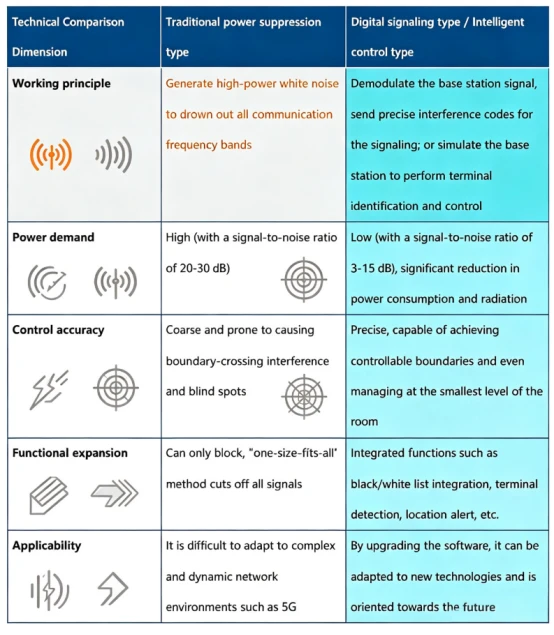
The early mobile phone blocking technologies mostly adopted the "full-band power suppression" mode, that is, by emitting high-power white noise to drown out all communication frequency bands. Although this method was simple and direct, its drawbacks were also quite obvious: high energy consumption, large radiation, prone to cross-border interference, and its effectiveness became increasingly difficult to guarantee as communication technology evolved.
In recent years, the communication control technology in detention facilities is undergoing a profound paradigm shift, evolving from a broad-based shielding approach to precise blocking at the signaling level.
1. Digital signaling shielding technology
This is the current mainstream and cutting-edge technology route. Its principle is based on the software radio platform. By real-time demodulating and synchronously tracking the signals from surrounding base stations, it generates targeted interference codes. The system collects base station signals through sampling antennas, identifies the control channel characteristics of different standards (2G-5G), and transmits interference signals of the same frequency and synchronization as the base station signals. This approach only blocks the signaling level and significantly reduces the required power threshold from the traditional scheme's 20-30 dB to 3-15 dB, fundamentally solving the industry pain points of high power, high radiation, and strong interference.
2. Intelligent detection and black/white list management
This is a more advanced technology that achieves an upgrade from "signal blocking" to "terminal control". The system no longer simply blocks all signals in a "one-size-fits-all" manner, but acts like a precise communication "security inspector". It can accurately identify each terminal as an authorized "white list" device (such as the police officer's police communication terminal) or an unauthorized "black list" mobile phone in a complex wireless environment. For unauthorized terminals, the system directly blocks their connection at the communication protocol level; for authorized terminals, it ensures smooth communication. This "selective access" technology achieves the intelligent control goal of "completely blocking what should be blocked and smoothly allowing what should be allowed".
Forth, Law, Ethics and Future Trends
Despite the increasing maturity of signal interference technology, the deployment of mobile phone signal blocking systems in prisons still faces legal and ethical discussions worldwide.
The use of mobile phone signal jammers in prisons is legally permissible as it is authorized by relevant laws. According to the laws, no entity or individual is allowed to use radio frequencies without authorization or cause harmful interference to legally conducted radio services. However, specific regulatory facilities such as prisons, after obtaining legal authorization, can use equipment that complies with national standards for signal control to prevent illegal communication and ensure public safety.
From an ethical perspective, the signal blocking in prisons often triggers discussions. The main points of contention are whether the system infringes upon the prisoners' freedom of communication and privacy rights, and whether it might prevent their right to seek help in emergency situations. However, from a legal standpoint, prisoners being deprived or restricted of some of their civil rights due to their violation of the law is a legitimate part of the criminal punishment process. The core mission of prisons is to ensure regulatory security and prevent recidivism, and blocking illegal communication is a necessary means to achieve this goal. A legal prison signal shielding system is designed to retain management areas and emergency communication channels, rather than cutting off all communication in a "one-size-fits-all" manner.
Therefore, when implementing signal control in prisons, they should choose formal products and solutions with authoritative qualifications certified by the state, ensuring that the equipment is only used within the authorized area and in the authorized manner, and is subject to the supervision of the radio management agency. This is not only a compliance with the law, but also a responsible act towards the public and the surrounding community.
The future signal control in prisons will be more intelligent, refined, integrated and green. The system will no longer be an isolated signal blocking device, but will be integrated into the entire intelligent prison security system and combined with artificial intelligence and big data analysis to achieve integrated control of "detection - identification - blocking - positioning - alarm". It not only can block signals, but also can automatically identify and warn of abnormal communication behaviors, transforming passive defense into active control. At the same time, green energy saving and low radiation will also become important considerations in product design, ensuring compliance with environmental protection and safety standards while maintaining strict control.

Fifth, Conclusion
The blocking of mobile phone signals in prisons is an extremely important technical defense line in modern prison security management. It is not merely a simple accumulation of technologies, but a complex system project that integrates radio frequency engineering, information technology, and security management. Its successful implementation relies on a profound understanding of the special prison environment, precise grasp of technical principles, strict requirements for engineering details, and strict compliance with laws, regulations, and ethical boundaries.
Facing the ever-changing communication technologies, prison management departments and interference equipment suppliers must continuously invest in research and development and upgrades to build a new generation of signal interference control system that is "effective in blocking, clear in boundaries, stable in operation, and controllable in intelligence". This is not only an inevitable requirement for maintaining absolute security within the prison walls, but also a responsibility to protect the communication rights of the public outside the prison and maintain social harmony and stability.

Disclaimer: This article is for reference only and does not provide legal or practical advice regarding prison mobile signal interference. The regulations for the use of prison signal jammer vary by region; actual deployment must comply with local laws and be carried out by authorized professional organizations.
We are a Chinese manufacturer. If you need a prison signal jammer and want to know more about its functions and usage methods, please contact us at info@alasartech-security.com.