Handheld Drone Detector:
A Complete Guide to Portable Drone Detection
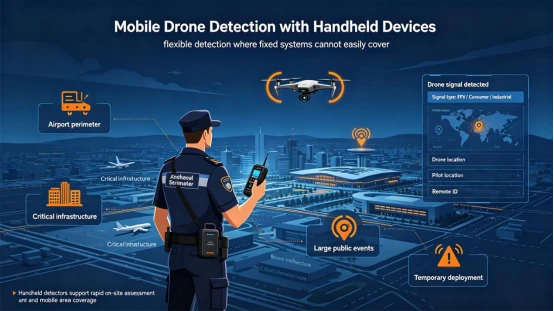
A handheld drone detector is a portable device used to detect and analyze radio frequency signals related to unmanned aerial vehicles (UAVs). Unlike fixed drone detection systems, handheld drone detectors can be carried by security personnel and used for mobile detection in different areas.
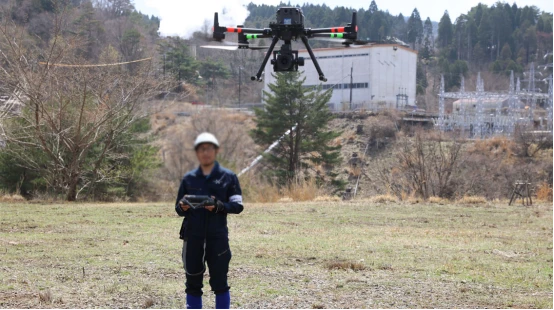
Handheld radio frequency drone detectors can identify signals from some consumer-grade drones, FPV drones, and industrial-grade drones. They can also analyze signals from suspected unknown drones to obtain information such as drone location, pilot location, and Remote ID.
一,How do handheld drone detectors work?
Radio frequency (RF) drone detectors typically involve the following steps:
1. RF Signal Monitoring: The device continuously monitors the selected frequency band, searching for numerous wireless signals that may coexist in the surrounding environment, such as Wi-Fi, Bluetooth, communication devices, and industrial equipment. Drone detection is not simply "detecting an RF signal and assuming it's a drone."
2. Signal Analysis: Once the device detects a relevant signal, it further analyzes frequency characteristics, signal patterns, and other features related to the specific drone's communication technology.
3. Drone Identification: The device compares the analysis results with known drone signal characteristics or an identification database. For supported drone models, the system can further determine its model or category. Some systems can also identify signals related to common FPV and industrial-grade drones.
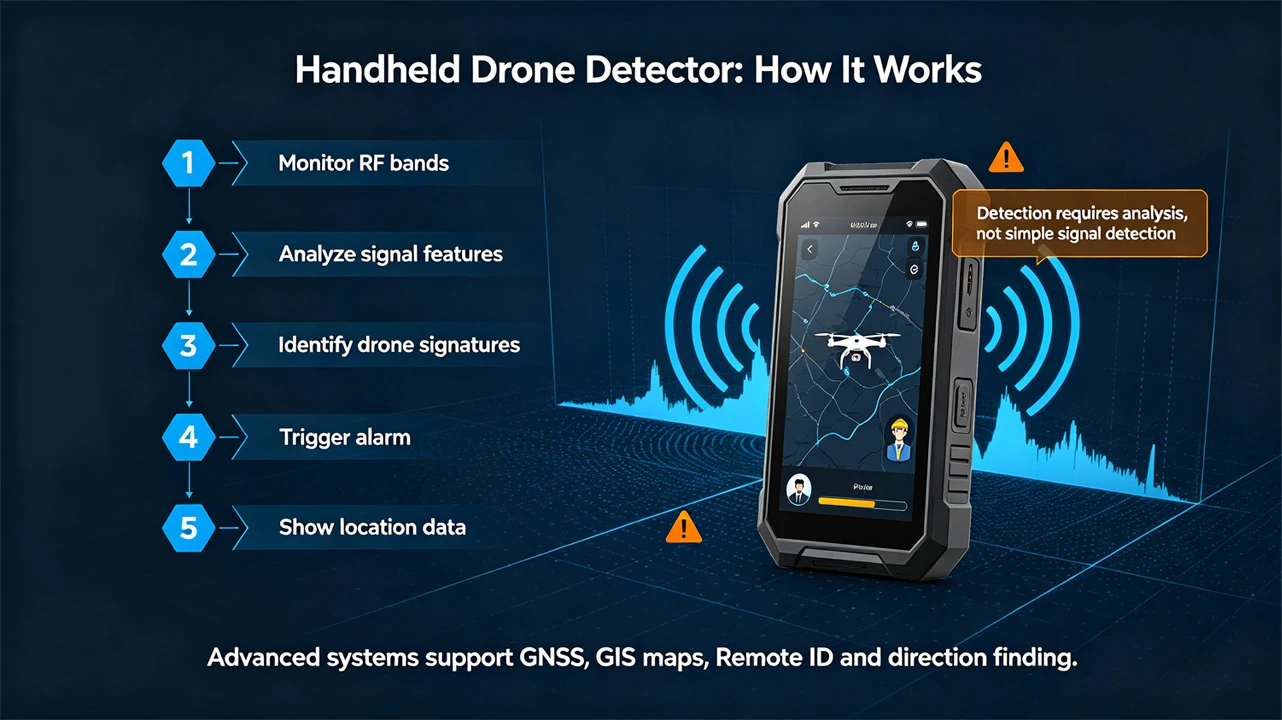
4. Alarms: When the system identifies a relevant drone signal or detects a suspected drone signal, it will issue an alarm to the operator. Alarm methods include screen notifications, sound alarms, and vibration alarms.
5.Location and Other Information: Advanced handheld drone detection systems can also combine radio frequency analysis with GNSS, GIS maps, Remote ID, and direction finding capabilities. Operators receive more than just a simple "drone spotted" notification; they receive a wealth of information about the situation on-site.
二,What types of drones can handheld drone detectors detect?
Actual detection capabilities depend on the device's frequency coverage, signal identification technology, antenna configuration, environment, and the signal characteristics of the target drone. Modern handheld drone detection systems can typically detect multiple drone types.
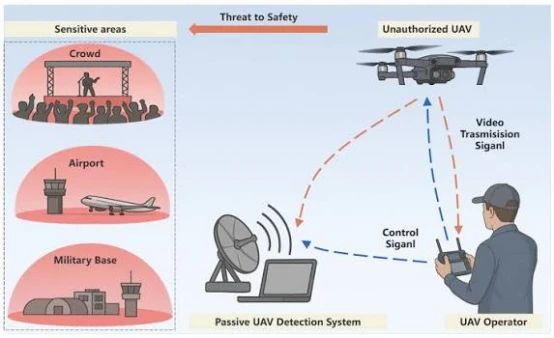
1,Consumer Drones: Consumer drones are a common type of UAV in public and commercial environments. Drone detectors with corresponding RFID capabilities can identify supported consumer drone signals and provide operators with relevant target information.
2,FPV (Flexible Printed Vehicle) Drones: Devices with corresponding RF analysis capabilities can monitor relevant FPV signals, providing security personnel with additional situational awareness of FPV drone activity.
3,Industrial Drones: Industrial drones include large multi-rotor drones, payload drones, and VTOL (Vertical Take-Off and Landing) or compound-wing drones. Handheld detectors that cover multiple drone types can help security teams monitor more types of UAVs, not just consumer drones.
4,Unknown or Suspected Drone Signals: Some advanced drone detection systems have added suspected drone signal identification capabilities. This feature can analyze radio frequency activity with UAV communication characteristics, and can issue a suspected UAV signal alarm to operators even if the specific model cannot be identified. Unknown RF signals do not necessarily represent UAVs. Suspected signal identification is better suited as an additional situational awareness capability than to automatically classifying all unknown signals as UAVs.
三,What is RF Drone Detection?
RF Drone Detection detects radio frequency (RF) activity associated with drones by monitoring and analyzing radio frequency signals.
One of its key features is that it can utilize the electronic signals generated by the drone to aid detection, rather than relying entirely on visual observation.
This can be particularly valuable in situations where:
• Drones are difficult to observe with the naked eye;
• Operators are at a distance from the drone;
• Weather or lighting conditions impair visual observation;
• Security teams require mobile detection capabilities;
•Large or temporary areas require drone monitoring.
Radio frequency (RF) detection also has technical limitations. Not all drones generate easily identifiable RF signals, and complex surrounding electromagnetic environments can affect detection effectiveness. Therefore, RF detection should generally be considered an indispensable part of an integrated drone detection system.
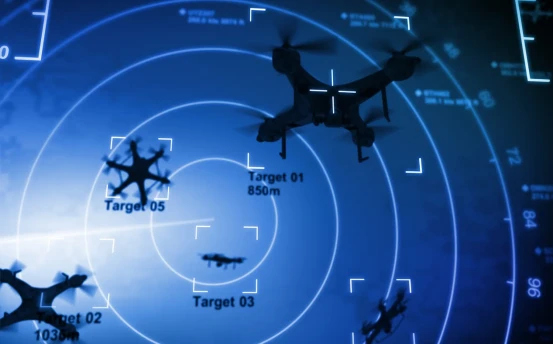
四,Why Choose a Handheld Drone Detector?
One of the biggest advantages of handheld drone detectors is their mobility.
Fixed detection systems can cover specific areas for extended periods, but handheld devices allow operators to take detection capabilities to where they are needed.
It is suitable for:
1,Mobile Security Patrols: Security personnel can carry the detector with them during patrols.
2,Temporary Events: Large events may require temporary drone surveillance where permanent detection infrastructure is not suitable.
3,Key Areas: Security teams can use portable drone detection equipment around sensitive facilities, industrial sites, and restricted areas.
4,Rapid Deployment: Handheld devices can be quickly deployed when potential drone activity is detected.
5,Integration with Other Detection Systems: Handheld RF detection devices can also be used in conjunction with fixed radar, cameras, acoustic detection equipment, or other UAV detection technologies.
五,How to Choose a Handheld Drone Detector?
When choosing a handheld drone detector, you shouldn't focus on just one parameter.
1. Frequency Coverage
Frequency coverage is one of the most important indicators for RF drone detectors.A wider frequency range allows the device to monitor more types of RF activity.
For example, the AAT-H3L-D supports RF detection from 70 MHz to 6000 MHz, providing 12 selectable key frequency bands by default.Additionally, other frequency bands can be configured according to project needs.
2. Detection Distance
Detection distance is affected by several factors, including:
•Electromagnetic environment;
•Target transmit power;
•Antenna configuration;
•Buildings and obstacles;
•Ambient RF interference.
The AAT-H3L-D's nominal detection distance is 1.5–2 km, but actual performance will vary depending on the environment and target transmit power. The product's nominal distance should be understood as a technical specification reference, not simply as a distance that can be achieved in all environments.
3. Drone Identification Capability
Simply detecting RF signals is not always sufficient. A good drone detection system should also help operators determine if the signal is related to a UAV and, where supported, further identify the drone model or type.
4. Remote ID
For compatible drone broadcasts, Remote ID can provide additional information. Devices supporting Remote ID resolution can obtain:
•Drone location;
•Pilot location;
•Drone serial number;
•Other available broadcast information.
5. Direction Finding
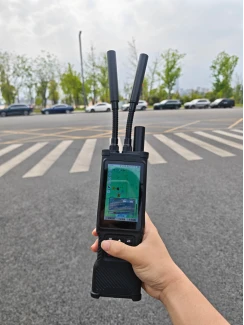
If the application scenario requires further determination of the signal's direction of origin, a device with direction finding functionality can be selected. The AAT-H3L-D supports an optional direction finding antenna, with a direction finding accuracy of approximately 15°. This helps operators determine the approximate direction of the detected RF signal on-site.
6. Battery Life and Portability
For mobile security applications, device weight, size, battery life, and carrying methods are all crucial.
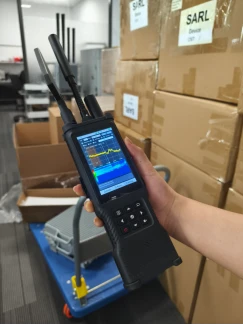
The AAT-H3L-D weighs ≤900 g and measures approximately 225 × 78 × 43 mm (excluding antenna), with a battery life of ≥6 hours. It also features a quick-release clip for use with MOLLE tactical gear.
7. Outdoor Protection: Electronic devices used outdoors may be affected by dust, moisture, and temperature variations.
The AAT-H3L-D has an IP55 protection rating and an operating temperature range of -20°C to 50°C.
七,AAT-H3L-D Handheld RF Drone Locator
The AAT-H3L-D is a handheld RF Drone Locator designed for portable drone RF detection and signal analysis.
The device employs a passive RF monitoring method, not actively emitting RF signals during detection, making it suitable for RF monitoring scenarios requiring low observability.
The AAT-H3L-D supports a frequency range of 70–6000 MHz, providing 12 selectable key frequency bands by default. The device can identify various drone signals, including supported consumer drones, FPV drones, and typical industrial drones.
For supported mainstream models, the system can further analyze information such as drone model, serial number, drone location, and pilot location, while also supporting Remote ID message parsing.
The device features a 4-inch color LCD screen and integrates GNSS positioning, GIS map interaction, spectrum detection, vibration and sound alarms, and supports optional directional antennas.
八,GNSS Mapping and Spectrum Analysis
The practical value of portable detection devices can be further enhanced when UAV detection information is combined with geographic location and electromagnetic environment information.
The AAT-H3L-D integrates GNSS positioning and GIS map interaction functions, allowing real-time display of the device's location and map operations on the screen.
1,Main map functions include:
•Real-time GNSS positioning;
•Map zooming;
•Satellite map;
•Standard map;
•Manual positioning (setting latitude and longitude);
•Detection mode and decoding mode
•DOA access to the direction finding interface
•Offline map data import.
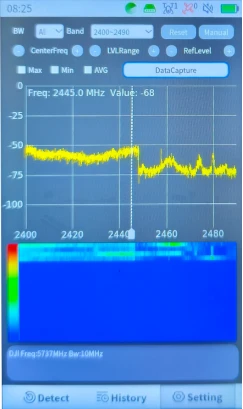
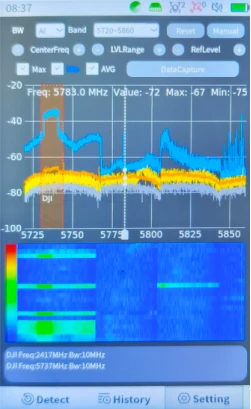
The device also supports real-time spectrum and time-frequency map display.
2,Spectrum functions include:
•Zoom in and out;
•Maximum value hold;
•Minimum value hold;
•Time-frequency analysis.
The AAT-H3L-D can be used not only as a portable UAV detector but also for basic handheld electromagnetic spectrum environment monitoring.
九,Application Scenarios of Handheld UAV Detectors
Portable UAV detection systems can be applied to a variety of security scenarios.
1,Large-scale Event Security
Security teams can use handheld UAV detection equipment at outdoor events, stadiums, public gatherings, and temporarily restricted areas.
2,Public Security Patrols
Mobile security personnel can carry the equipment during patrols to monitor potential UAV activity, without relying entirely on fixed detection infrastructure.
3,Protection of Key Areas
Sensitive facilities and important areas can use portable UAV detection as an additional technical means of low-altitude situational awareness.
4,Counter-UAS Applications
Handheld RF detectors can serve as detection and identification components in a more complete Counter-UAS system.
It is important to note that detection and jamming are different functions. The primary responsibility of a drone detector is to detect, analyze, and identify potential drone activity; however, this does not mean that the device itself possesses jamming or other countermeasure capabilities.
十,Conclusion: How to Choose the Right Handheld Drone Detector?
Handheld Drone Detectors provide security teams with flexible, portable, and rapidly deployable drone detection capabilities.
When selecting equipment, you shouldn't focus solely on detection range. Frequency coverage, signal analysis capabilities, drone identification, Remote ID, unknown signal identification, direction finding, GNSS mapping, battery life, protection level, and system integration capabilities all significantly impact the equipment's value in practical applications.
For any inquiries, please contact us: info@alasartech-security.com