In confidential areas, important meetings or privacy protection scenarios, illegal transmission of wireless signals may lead to risks of information leakage. The handheld WiFi security detection device, as a portable signal detection equipment, can quickly locate and analyze the wireless signals in the surrounding environment, helping managers identify potential risks. Its core function is to scan specific frequency bands to detect whether there are unauthorized Bluetooth, 5G, WiFi and other signal sources, and mark the signal strength and location, providing technical support for security protection.
First, Analysis of Working Principle and Core Structure
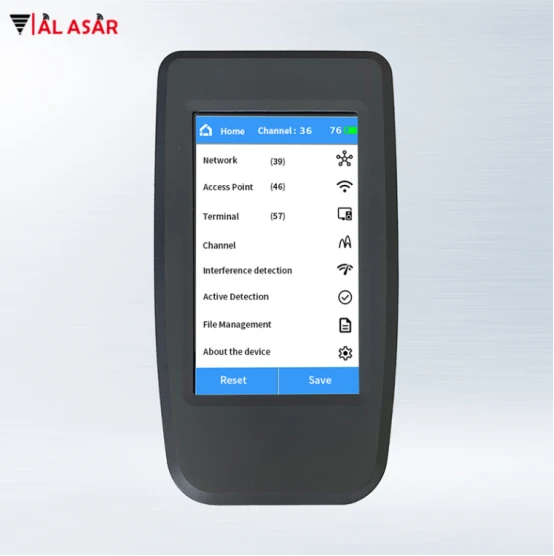
The handheld WiFi security detection device receives the wireless signals transmitted by the mobile phone and the wireless access point during communication, demodulates and analyzes the target signals, thereby analyzing and summarizing the surrounding wireless signals. At the same time, it can precisely locate the target by measuring the wireless signal strength of the WIFI terminal. It also supports interfering with and counteracting the target's wireless signals to prevent them from conducting normal network activities.
This device uses domestic integrated hardware equipment with the Linux operating system. Its core technology is as follows: The RF module adopts a dual-band antenna design (including a 6dB gain antenna and an external expansion interface), ensuring the weak signal capture capability with a high receiving sensitivity of -90dBm; The protocol stack supports the full range of standards from WiFi3 to WiFi6 for parsing, enabling the device to identify various new attack behaviors.
Second, how do technological differences affect practical applications
The omnidirectional characteristic of the built-in antenna complements the directional enhancement of the external antenna: the former is suitable for rapid panoramic scanning (5 seconds per time), while the latter is designed for in-depth analysis of distant targets. The customization advantage of domestic hardware lies in the precise adaptation to the CN wireless frequency band, while the Linux system provides flexibility for underlying protocol analysis. These design differences directly result in a reduction of the false alarm rate of the equipment in complex electromagnetic environments.
Third, application scenarios
1. Confidentiality and security protection:
In government agencies, military organizations, and research institutes, check for unauthorized wireless routers, hidden WiFi cameras, and illegal hotspots to prevent wireless espionage. This should be used in conjunction with physical isolation strategies.
2. Examination Venue and Large Event Security:
Detect wireless invisible headphones, cheating transmitters, and unauthorized communication signals to maintain exam fairness and public order.
3. Personal and Family Security Audit:
Detect neighbor signal interference, weak encryption configurations, and signal leakage areas to optimize the security of one's own network.
Fourth, Important Notes
1. When using the handheld WiFi security detection device, it is necessary to abide by relevant laws and regulations and not be used for illegal purposes;
2. Regular maintenance and care should be carried out for the device to ensure its normal operation;
3. If any problems occur during use, contact professional technicians for repair or replacement in time.
Fifth, Conclusion
In summary, the handheld WiFi security detection device, as an important type of wireless signal detection equipment, has extensive applications in various fields. By understanding its working principle and usage method, we can better utilize its functions and enhance the security of the wireless network environment.
We are a Chinese manufacturer specializing in customizing handheld WiFi security detection devices for detection and interference. We offer a variety of handheld WiFi security detection devices for you to choose from or customize. If you have any requirements, please contact us at info@alasartech-security.com.