In an era that increasingly relies on wireless communication, the ability of jamming devices to interfere with signals has become a topic of great concern, whether for security, privacy, or countermeasures purposes. For anyone exploring the field of signal jamming, the most common and crucial question is: What factors determine the interference distance of a jammer, or what is its actual interference range?
However, the answer to this question is not straightforward. The interference distance of a jammer is not a fixed and conventional value. Instead, it is a highly variable dynamic result that is influenced by physical, technical, and environmental factors. This article will provide you with an in-depth analysis of the relevant knowledge about the interference distance and range of jamming devices.
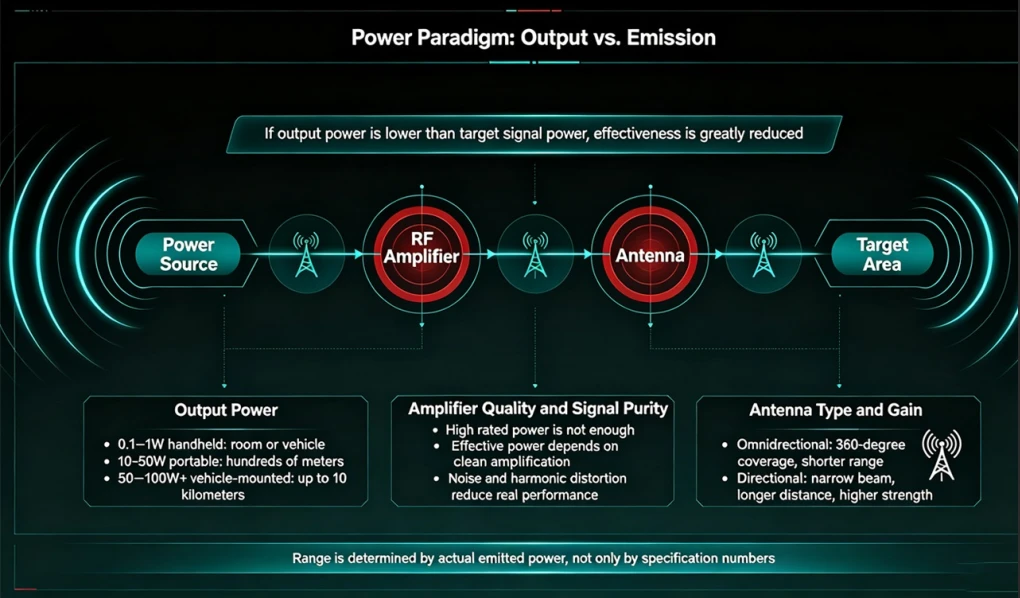
First, power paradigm: Output vs. Emission
The most fundamental factor determining the range of an interference device is its emission power. Generally speaking, the higher the power, the larger the potential range. If the output power of the interference device is lower than the power of the target signal, its effectiveness will be greatly reduced.
1.Output power (watts/dBm)
The power of an interference device is usually measured in watts (W) or decibel milliwatts (dBm). The power range varies significantly depending on the intended use of the equipment.
(1) Low-power handheld interference device:
The output power may be only 0.1 - 1W. Its effective range is usually limited to a single room or within a vehicle, and for protocols such as Wi-Fi, it may only be 10 - 20 meters.
(2) Medium-power portable interference device:
Devices with a power of 10 - 50W can interfere with signals within a radius of several hundred meters, suitable for buildings or small events.
(3) High-power/vehicle-mounted interference device:
This type of device is typically used in military or border security. Each frequency band can output 50 - 100W or even higher power. These devices can reach a range of up to 10 kilometers.
2. Amplifier Quality and Signal Purity
The quality of the RF (Radio Frequency) amplifier is equally important. A cheap jammer might have a high rated power, but the actual power is very low, and the generated signal is "not clean", with a lot of noise and harmonic distortion. An efficient and high-quality amplifier can ensure that most of the output power is concentrated at the target frequency, thereby maximizing its interference effectiveness over long distances.
3. Antenna Type and Gain
The antenna is the final output component of the interference device's transmission chain. The design of the antenna has a significant impact on the distance and range of the interference area. Antenna gain measures the effectiveness of the antenna in converting input power into effective radio waves in a specific direction.
(1) Omnidirectional Antenna:
This type of antenna provides a 360-degree horizontal radiation pattern, offering coverage in all horizontal directions. Typical Wi-Fi interference devices' omnidirectional antennas usually have a coverage range of 15 to 20 meters and low power. Its advantage is that it can usually work by simply being vertically installed, without the need for a complex alignment process, reducing installation costs and time.
(2) Directional Antenna (such as Yagi antenna, flat antenna, parabolic antenna):
These antennas concentrate RF energy in a certain direction. The beam angle on the horizontal plane may only be a few degrees or even narrower, sacrificing coverage in other directions in exchange for a longer transmission distance and stronger signal strength in this direction. Under the same output power, the coverage distance of directional antennas is much greater than that of omnidirectional antennas. Therefore, high-power military interference devices often use directional flat antennas, which can achieve a coverage range of several kilometers.
Second, Environment: The Silent Partner Amidst Interference
Deploying radio frequency jamming devices in actual environments is often a dynamic and unpredictable variable, serving as an application for converting theoretical scope into practical effect.
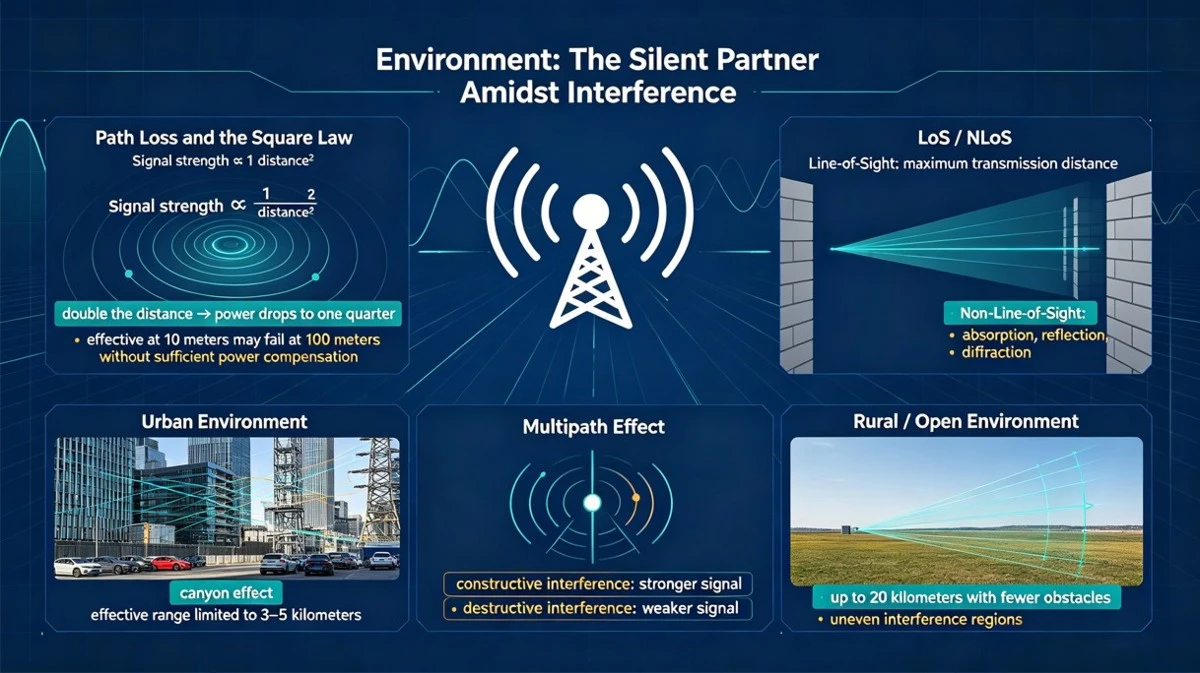
1. Path Loss and the Square Law
In free space, the signal strength decays inversely with the square of the distance from the source. This simple physical principle indicates that whenever the distance of the jammer doubles, the signal power will drop to one quarter of the original. This rapid attenuation means that a jammer that is extremely effective at 10 meters may completely fail at 100 meters if it does not have sufficient power to compensate for the path loss.
2. Line-of-Sight (LoS) and Non-Line-of-Sight (NLoS)
Radio signals are severely affected by physical obstacles. If there is a clear line-of-sight (LoS) path between the antenna of the interference source and the target receiver, the maximum transmission distance can be achieved.
However, in most practical scenarios, we encounter non-line-of-sight (NLoS) conditions. Physical structures absorb, reflect and diffract signals, causing significant signal attenuation.
(1) Urban environment:
Dense buildings, vehicles and metal objects create a "canyon" effect, with signals constantly being reflected and blocked, limiting the effective range to 3 to 5 kilometers.
(2) Rural/Open environment:
With fewer obstacles and good visibility, signals can travel further. Some portable radio frequency interference devices have coverage ranges of up to 20 kilometers.
3. Multipath Effect
In complex environments, the signal travels through multiple paths (direct, reflected, and diffracted) to reach the receiver. At the receiver location, these signals may undergo constructive interference (enhancing the signal) or destructive interference (weakening the signal). This phenomenon, known as the multipath effect, can cause abnormal strong or weak interference signals in certain areas, thereby forming highly uneven interference regions. Such multipath effects can significantly impact the performance of interference attacks.
Third, Objective: Understand the enemy's signals
The jammer does not operate in a vacuum; it is always targeting specific target signals. The characteristics of the target are crucial for determining the difficulty of the jamming task and the final coverage area.
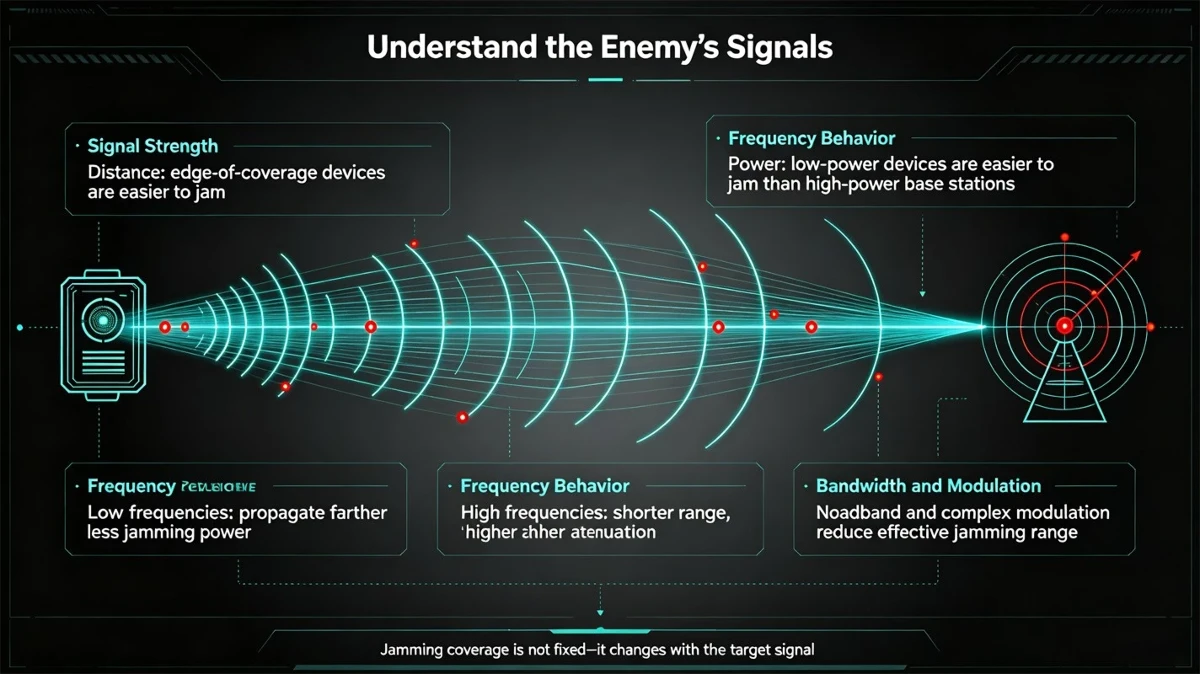
1. Target signal strength
This is the most critical variable in the interference signal ratio (J/S) equation. The jammer is much more effective against weak target signals than against strong signals.
(1) Distance to the target transmitter:
Devices closer to the base station have stronger signals, so they are more difficult to be interfered with than devices at the edge of the network coverage.
(2) Target transmitter power:
It is very difficult to interfere with a high-power base station (such as a base station tower) from a distance, while interfering with a low-power device (such as a Wi-Fi router or smartphone) is relatively easier.
2. Frequency Band and Propagation Characteristics
Different frequencies behave differently in the environment. Low frequencies (such as the VHF/UHF frequency bands used for certain drone control) can propagate farther and penetrate obstacles better than high frequencies (such as 2.4 GHz, 5.2 GHz, and 5.8 GHz frequency bands used by Wi-Fi and many consumer-grade drones). Therefore, the effective range of the jammer also depends on the frequency band it is attempting to interfere with. For example, the ALASAR Portable Bomb Multi-Frequency Jamming System covers multiple frequency bands from 20 MHz to 5.8 GHz and provides different output powers for each frequency band to achieve effective jamming.
3. Signal Bandwidth and Modulation Method
The output of the jammer can also be compared with the signal it is targeting. Jamming narrowband signals is generally easier to achieve than jamming broadband signals, and it requires less power. More complex modulation schemes may require different jamming techniques to be effective in disrupting, which may affect the effective range of the jammer.
Fourth, the design and technology of the jammer
The internal structure and complexity of the jammer itself also play a significant role in its overall performance and effective range.
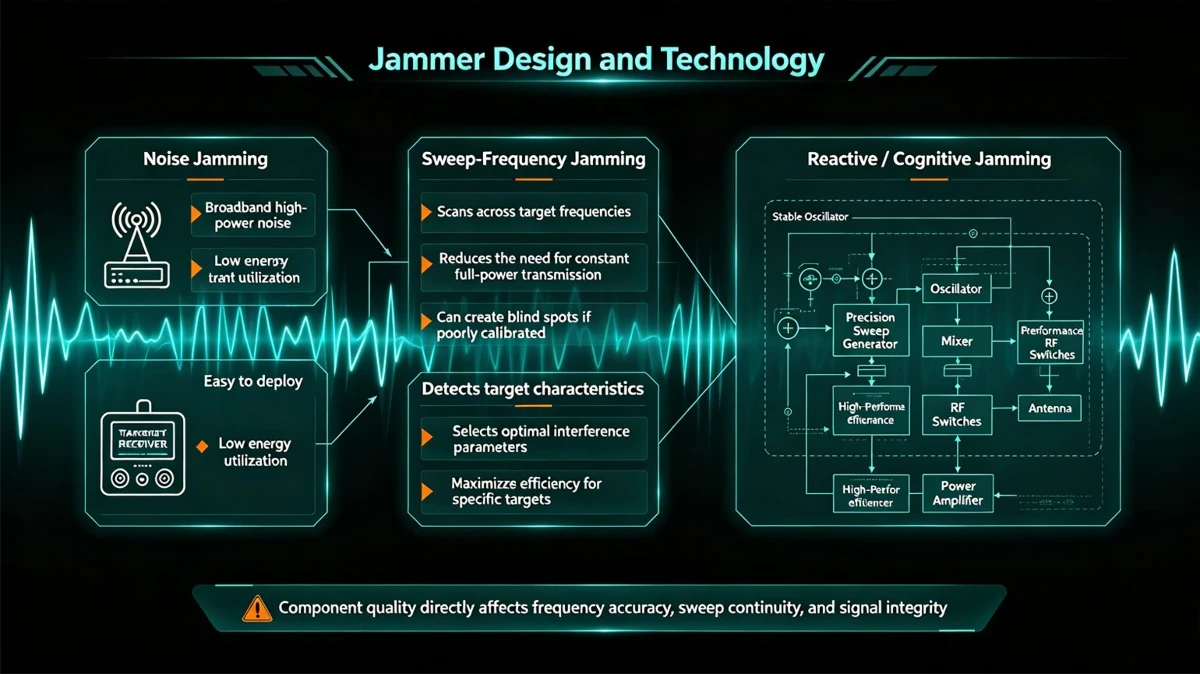
1. Interference techniques: Noise interference, sweep-frequency interference and reactive interference
(1) Noise/dense interference:
High-power noise is transmitted over a wide frequency band. This method is simple and effective, but has low energy utilization efficiency, which may reduce the effective distance under a specific output power.
(2) Sweep-frequency/directional interference:
The interference device scans the output signal within the target frequency range. This method is more efficient because it does not require a one-time high-power coverage of all frequencies. Research shows that combining sweep-frequency signals with noise can overcome the limitations of a single technology, such as insufficient noise spectral density or the problem of interference blind areas.
(3) Reactive/cognitive interference:
This is the most advanced technique. The interference device "listens" to the target signal, analyzes its characteristics (frequency, modulation method), and then emits an accurately optimized interference signal to disrupt its signal. This method can achieve extremely high efficiency and is expected to maximize the interference distance for a specific target.
2. Quality of Internal Components
The quality of internal components such as oscillators, mixers, and sweep generators can significantly affect performance. A stable and precise oscillator ensures that the jammer remains at the correct frequency. In sweep interference devices, a slow and inaccurate sweep speed can create "blind spots", resulting in the omission of certain frequencies that need to be interfered with, thereby reducing the effectiveness of the interference. The use of high-quality RF switches is crucial for ensuring seamless signal generation and maintaining the integrity of the interference signal.
Fifth, actual scope: From the office desk to the battlefield
Understanding the theory is important, but only by seeing the combined effect of these factors in the real world can one obtain the clearest understanding. In the real world, there is no single "disturbance distance"; instead, depending on the type of disturbance equipment and design goals, there are a series of possible disturbance ranges.
1.Types of jamming devices classified by range
|
Type of jammer |
Typical output power |
Application scenario |
Actual range |
The main limiting factors |
|
< 1W |
Personal privacy protection, preventing the use of mobile phones in small rooms |
10-50 meters |
Output power is low; it is greatly affected by obstacles. |
|
|
5W - 50W |
Ensure the safety of meeting rooms, small examination rooms and vehicles |
50 - 300 meters |
Power and antenna design; the environment plays a significant role. |
|
|
Backpack / Individual Carryable |
10W - 100W |
Military team protection, VIP security |
500meters - 2kilometers |
Battery life and heat dissipation; directional antennas are crucial. |
|
High power / Vehicle-mounted / Fixed type |
每频段50W - 100W |
Base protection, perimeter security, anti-drone measures |
2 kilometers - 10 kilometers and above |
Power supply; usually requires a clear line of sight to the target. |
Sixth, Conclusion
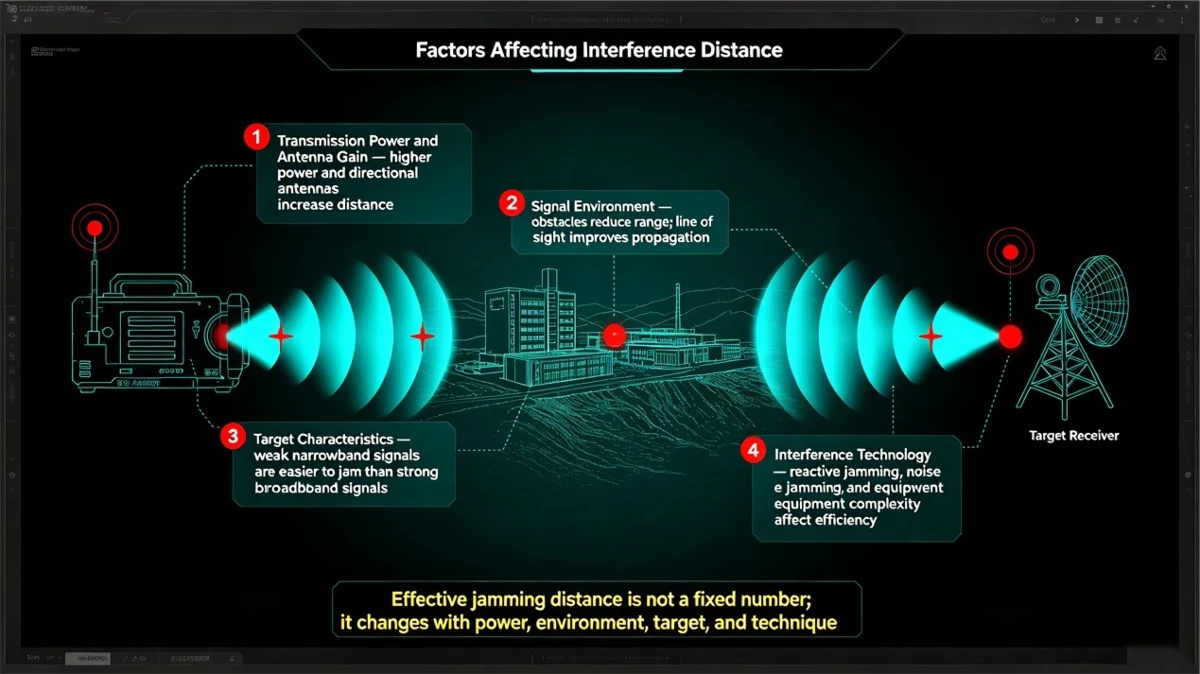
The interference distance is related to the following factors:
1. Transmission power and antenna gain:
These are the main factors affecting the transmission distance. Higher power and more focused antennas can achieve a longer transmission distance.
2. Signal environment:
The "topography" of the radio frequency spectrum. Obstacles such as buildings and terrain can significantly reduce communication distance, while clear line of sight can extend its range.
3. Target characteristics:
The strength and nature of the signal you are trying to interfere with. Weak narrowband signals are easier to interfere from a distance than strong broadband signals.
4. Interference technology:
The complexity of the equipment (such as reactive interference and noise interference) determines the efficiency of its power usage.
When evaluating radio frequency jamming devices, one should not merely focus on marketing claims such as "within a kilometer range". The truly effective distance should be the actual distance achieved in a specific environment for a specific target. Understanding the principles described in this article is the first step in setting reasonable expectations and making informed technical decisions.
Disclaimer: This article is for reference only and does not provide legal or practical advice regarding signal interference. The regulations for the use of signal jamming devices vary by region, and actual deployment must comply with local laws and be carried out by authorized professional organizations.
We are a Chinese manufacturer. If you need a signal jammer, please contact us at info@alasartech-security.com.