With the development of smartphones, digital voice recorders, wireless microphones, and various portable smart devices, unauthorized recording has become an increasingly significant issue for corporate information security and personal privacy protection.
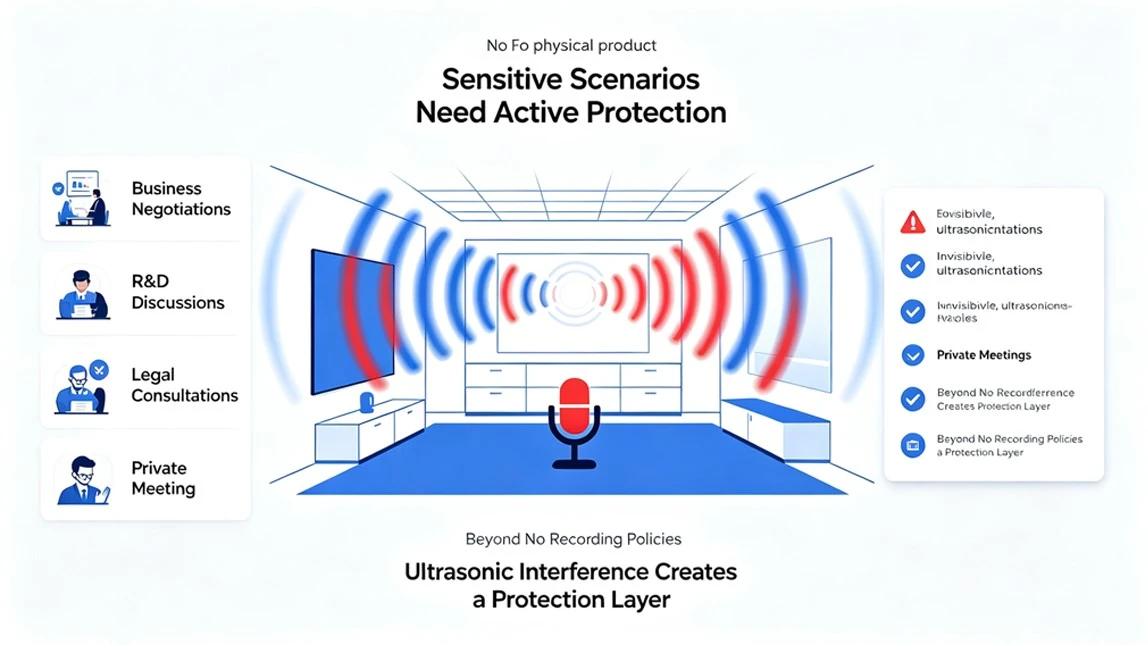
In business negotiations, board meetings, R&D discussions, legal consultations, private meetings, and other sensitive scenarios, simply relying on "no recording" policies is insufficient to completely eliminate the risk of recording. Some professional privacy protection solutions are beginning to employ specialized acoustic technologies to add a layer of active protection to the target area. Among these, the ultrasonic audio jammer is a representative acoustic privacy protection device.
Unlike traditional white noise generators, the core idea of the ultrasonic audio jammer is not to fill the room with audible noise, but rather to use high-frequency acoustic interference to affect the normal sound pickup of nearby microphones. Related research shows that ordinary microphones and their electronic circuits have nonlinear characteristics, which can generate interference that can be perceived by the microphone system under the influence of specific ultrasonic signals, thereby reducing the quality of voice recordings.
What is an Ultrasonic Audio Jammer?
An ultrasonic audio jammer can be understood as an "ultrasonic audio jammer" or "ultrasonic microphone jammer." It is not the same technology as RF signal jamming devices such as cell phone signal jammers and GPS jammers.
RF jammers primarily target radio communication signals, while ultrasonic microphone jammers mainly generate acoustic interference in a localized space, aiming to reduce the microphone's effective voice pickup capability.
This distinction is important because the technical principles, application scenarios, and legal regulations involved in the two types of products may be completely different.
How do ultrasonic microphone jammers work?
A microphone first converts changes in sound pressure in the air into electrical signals, which are then processed by front-end circuitry and a digital signal processing system to form the final recording. Microphones only record effective sound within the range of the human ear.
However, actual electronic components are not perfectly linear. When a microphone is affected by specific high-frequency acoustic signals, nonlinear effects in the electronic circuitry can generate additional signal components, thus interfering with normal speech acquisition.
It can be simply understood as:
Ultrasonic signal → Undesired microphone response → Interference with recording signal → Decreased speech intelligibility
Academic research has experimentally investigated this ultrasonic jamming method based on the nonlinear characteristics of microphones. Related studies show that by designing appropriate ultrasonic jamming signals, the speech recognition effect in recordings can be significantly reduced. Of course, the hardware design of different mobile phones, recording devices, and microphones varies. The actual effect of any ultrasonic audio jammer needs to be evaluated in conjunction with the specific equipment and usage environment.

Why is the Mini 360° 3D design worth paying attention to?
Because of its directionality, if ultrasound waves primarily propagate in one direction, the microphone on the other side of the device will be in a relatively weak interference zone.
This is why a 360° angle is designed for omnidirectional interference. The Mini 360° 3D ultrasonic audio jammer is designed to extend interference coverage as horizontally and vertically as possible through multiple acoustic output units or a well-planned sound field layout. For roundtable meetings, small conference rooms, offices, negotiation tables, and environments with multiple people communicating face-to-face, this design establishes a more complete acoustic protection zone than a simple directional sound source.
Academic research also indicates that traditional ultrasonic jammers are easily affected by angle and direction, while a multi-directional sound source design can help reduce some blind spots.
What are the advantages of the Mini Ultrasonic Audio Jammer?
Miniaturization doesn't necessarily mean weaker product performance, because many designs aim to protect a specific "conversation area," rather than covering the entire building.
The advantages of a mini ultrasonic audio jammer are as follows:
• Compact size: More suitable for environments such as conference tables and office desks.
• Flexible deployment: It can be moved according to the meeting location.
• Minimal visual impact: Easier to blend into a business environment.
• Highly targeted: The scope of protection is concentrated on areas that truly require confidentiality.
• Easy to operate: Professional equipment typically emphasizes quick start-up and low learning costs.
Professional audio interference solutions are increasingly emphasizing the concept of "the scenario determines the equipment," rather than simply pursuing the maximum distance. Coverage range, number of devices, user comfort, installation location, and actual usage needs need to be considered comprehensively.

What is the difference between an Ultrasonic Audio Jammer and a white noise jammer?
White noise jammers primarily mask speech by generating broadband noise that is audible to the human ear. However, this method has a significant drawback: people in a protected room will still hear the noise continuously.
For example, in board meetings, business negotiations, legal consultations, or high-level conferences, continuous noise can interfere with normal communication. One of the main advantages of an ultrasonic audio jammer is that it focuses the interference as much as possible at the microphone level, while minimizing the impact on normal conversation. However, "virtually inaudible" does not mean "completely free of acoustic interference in all situations."
The output level, distance, and duration of an ultrasonic system still need to be properly controlled. World Health Organization data on hearing safety emphasizes that the risk of sound exposure is related to factors such as sound level and exposure time; therefore, professional equipment should be designed and used with acoustic safety and human comfort in mind.
Which recording devices can the Ultrasonic Audio Jammer protect?
In suitable application environments, ultrasonic microphone jammers can serve as an active layer of protection against unauthorized recording.
Common targets include:
·Smartphone microphones
·Digital voice recorders
·Voice recorders
·Some portable recording devices
Some professional solutions for wireless or hidden microphones are typically designed for corporate meeting rooms, business negotiations, private meetings, R&D environments, and other scenarios requiring the protection of sensitive conversations. It's important to emphasize that the performance of different devices can vary significantly. Factors such as microphone model, directionality, digital noise reduction algorithms, automatic gain control, distance, placement angle, and room reflections all affect the final result.
Therefore, in professional applications, the quality of a product cannot be judged solely by its "maximum interference distance."
What should you pay attention to when choosing a Mini 360° 3D Ultrasonic Audio Jammer?
1. Actual coverage
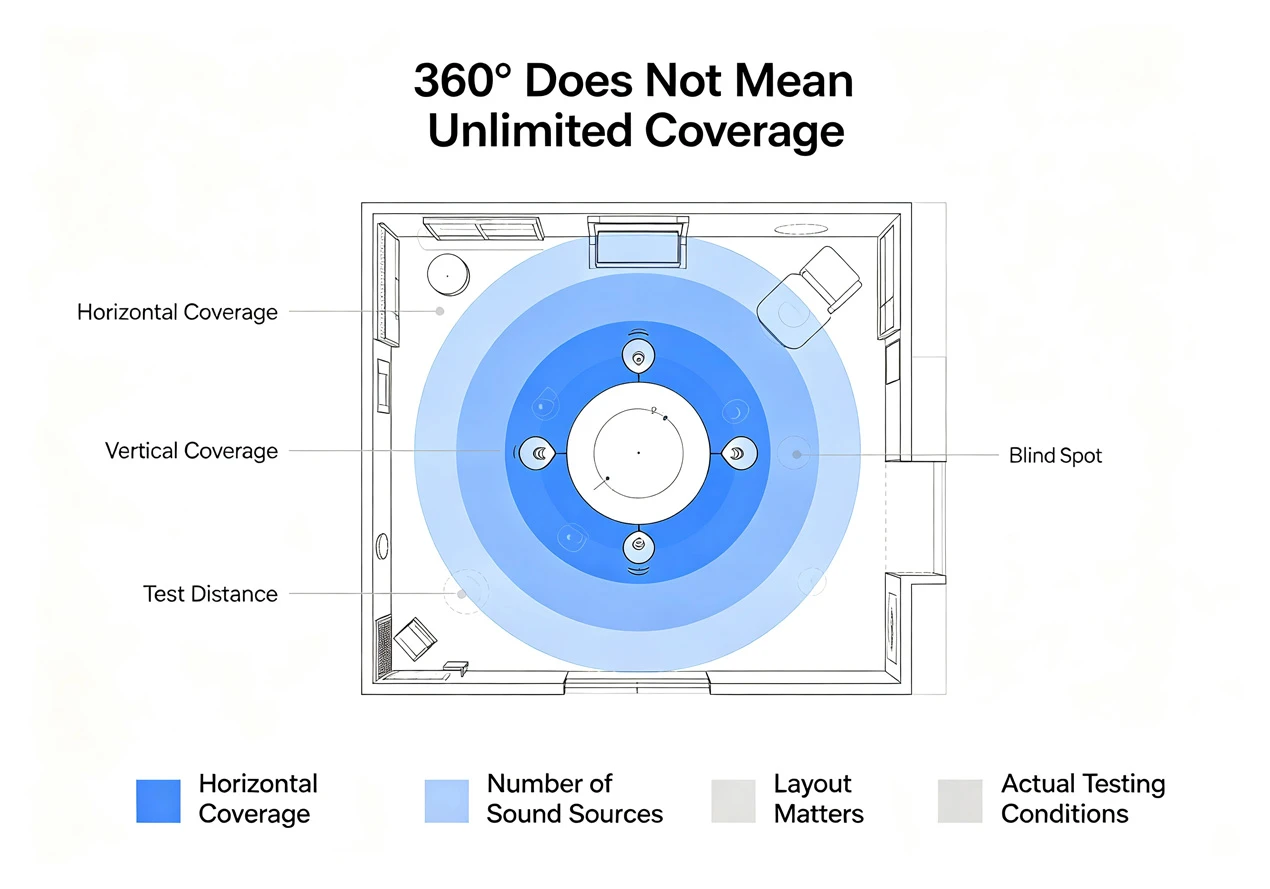
First, it's necessary to understand the product's actual horizontal and vertical coverage capabilities. "360°" should not be interpreted solely as a marketing parameter, but rather should be judged in conjunction with the number of sound sources, their layout, and actual testing conditions.
2. Ultrasonic Transducer Quality
Ultrasonic transducers are an important component of the equipment. Transducer efficiency, frequency response, consistency, and long-term stability all affect the actual performance of the equipment.
3. Signal Design
Modern smartphones possess sophisticated digital audio processing capabilities. Therefore, ultrasonic audio jammers do not simply increase output power, but place greater emphasis on interference signal design and overall system matching.
4. User comfort
Higher power is not always better. Excessive output can increase discomfort for people on site, and may even produce perceptible high-frequency sounds or a sense of pressure. Professional design should strike a balance between interference reduction, coverage, and user comfort.
5. Actual test data
Actual testing is more important than simply claiming specifications. Credible product testing should specify the testing environment, equipment type, distance, recording device placement, and final recording quality.
Make-up claims such as "100% effective" or "can be blocked by any device" without supporting testing conditions should be viewed with caution.
Is the 360° Ultrasonic Audio Jammer 100% effective?
The propagation effectiveness of ultrasound is affected by distance, obstacles, room structure, device orientation, and the microphone's design. Strictly speaking, 100% effectiveness is unlikely and depends on the specific situation and environment.
For example, a highly directional professional microphone and a regular mobile phone microphone may respond differently to the same type of ultrasonic interference.
Therefore, professional security solutions typically emphasize "protecting the target area" rather than promising absolute effectiveness in all situations. The ultrasonic sound field is affected by distance and the actual environment; in complex conference room environments, a reasonable number of devices and strategic placement may be more important than pursuing the ultra-long range of a single device.

Can the Ultrasonic Audio Jammer App replace hardware devices?
This is an area where consumers often misunderstand. Some users might search for "ultrasonic audio jammer app" to achieve ultrasonic jamming through mobile software. However, there is a clear difference between mobile apps and professional hardware. Ordinary mobile phone speakers are primarily designed for audible sound and cannot be simply equated with professional ultrasonic transducer arrays.
Software-level microphone access control still has some privacy value, but it addresses operating system and software permission issues. Hardware ultrasonic audio jammers, on the other hand, provide physical acoustic protection by affecting surrounding microphones through external sound fields. Therefore, they are more suitable as different levels of security measures than simple substitutes.
In which scenarios is the Mini 360° Ultrasonic Audio Jammer suitable?
For small, private meetings of two to four people, the Mini ultrasonic audio jammer is usually more effective.
If it is a large conference room, further consideration should be given to:
·Room size
·Tabletop layout
·Participant locations
·Number of recording devices that may be present
·Coverage relationship between devices
·Room acoustic structure
For highly sensitive environments such as government agencies, corporate executives, R&D departments, and law firms, a more appropriate approach is to integrate ultrasonic audio jammers with access control, mobile phone management, cybersecurity, physical security, and employee security awareness training. Professional privacy protection should be a system, not a single "one-size-fits-all" device.

Legal and safety precautions
Before purchasing or using any jammer, it is essential to verify the relevant laws and regulations of your country or region.
It is important to note that ultrasonic audio jammers and RF signal jammers are not entirely the same technology category, and the fact that they are both called "jammers" does not automatically mean that the laws apply to them.
For example, the US FCC explicitly prohibits consumers from using signal jamming devices that intentionally interfere with licensed wireless communications and imposes strict regulatory measures on illegal use, sale, and importation.
Therefore, if a product involves interference with wireless communications such as RF, cellular, Wi-Fi, or GPS, its legal risks need to be assessed separately from those of a simple acoustic privacy protection device.
Before deploying in any country or region, you should verify the actual technical attributes of the product and consult applicable local regulations.
Summarize
The core value of the Mini 360° 3D ultrasonic audio jammer lies not merely in "emitting ultrasonic waves," but in creating a more discreet acoustic privacy layer within a specific conversation area through well-designed sound source, spatial coverage, and signal control. An ultrasonic microphone jammer should comprehensively consider: 360° spatial coverage + ultrasonic transducer quality + signal design + user comfort + real-world testing + deployment environment + legal compliance.
For corporate meetings, business negotiations, R&D discussions, private conversations, and other sensitive communication scenarios, the Mini 360° 3D ultrasonic audio jammer can serve as an integral part of a comprehensive information security system.
Truly professional choices are not simply about pursuing "maximum power" or "longest distance," but about finding a balance suitable for the specific scenario. Ultimately, coverage effectiveness, actual test results, device compatibility, user experience, and compliance are the key factors in evaluating whether an ultrasonic audio jammer is truly worth using.
Small recording devices are now ubiquitous, making meeting bans alone insufficient to prevent covert recordings. Ultrasonic audio jamming technology offers a new approach to privacy protection: unlike disturbing white noise, it utilizes the non-linear characteristics of microphone hardware to interfere with recordings, minimizing disruption to normal conversations. Compact mini versions can also provide flexible, scenario-based protection for meeting rooms and negotiation settings.
However, this technology is not a panacea. Actual effectiveness is affected by room environment, microphone model, and hardware quality. When selecting a device, one should not blindly trust claims of "100% effectiveness," but rather comprehensively consider coverage, transducers, signal algorithms, human comfort, and prioritize real-world testing data.
Ultimately, ultrasonic jamming can only supplement security measures and cannot replace standardized internal management systems. Only by combining it with appropriate security procedures can it provide truly effective auxiliary protection for highly sensitive conversations in business, legal, and R&D fields.
We are a Chinese manufacturer of audio jammers. If you are interested in our audio jammers and would like to learn more about their functions and usage, please contact us at info@alasartech-security.com. For more information, please visit our website www.alasartech-security.com/.
Disclaimer: This article is for technical information and privacy education purposes only. Actual product performance may vary depending on the recording equipment, distance, room layout, equipment placement, and environmental factors. Before using any of these devices, please comply with local laws and regulations, applicable safety standards, and the manufacturer's instructions.