In today's highly information-developed era, the threats to personal privacy and corporate secrets far exceed imagination. From the hidden pinhole cameras in hotels to the hard-to-detect eavesdropping devices in offices, and even the ubiquitous mobile phone Trojans, anti-eavesdropping and anti-eavesdropping have become a rigid demand for modern people to safeguard their security and dignity. In the face of hidden threats, anti spy detector have become a key line of defense for safeguarding private Spaces.
First, invisible threats: Why Professional Testing Is Needed?
Modern means of espionage are increasingly covert and intelligent.
1.Miniaturized devices: Pinhole cameras can be disguised as screws, smoke alarms, or even power sockets. Miniature eavesdroppers can be hidden inside furniture and electrical appliances.
2.Wireless transmission: A large number of monitoring devices transmit data remotely via Wi-Fi, Bluetooth, mobile networks or specific radio frequency signals, making it difficult to trace the source.
3.Software intrusion: Once mobile phones and computers are infected with spyware, calls, messages, locations and even cameras may all be remotely controlled.
4.Laser monitoring: Utilizing laser beams to detect the vibration of window glass and restore indoor conversations.
It is simply impossible to detect these carefully hidden threats merely by visual inspection and routine checks. Professional anti-eavesdropping detection equipment precisely makes these "invisible ones" have nowhere to hide through technical means.
Second, core weapon: Classification of professional anti-eavesdropping detection equipment
According to the working principle and detection target, mainstream anti-eavesdropping detection devices can be classified into the following categories:
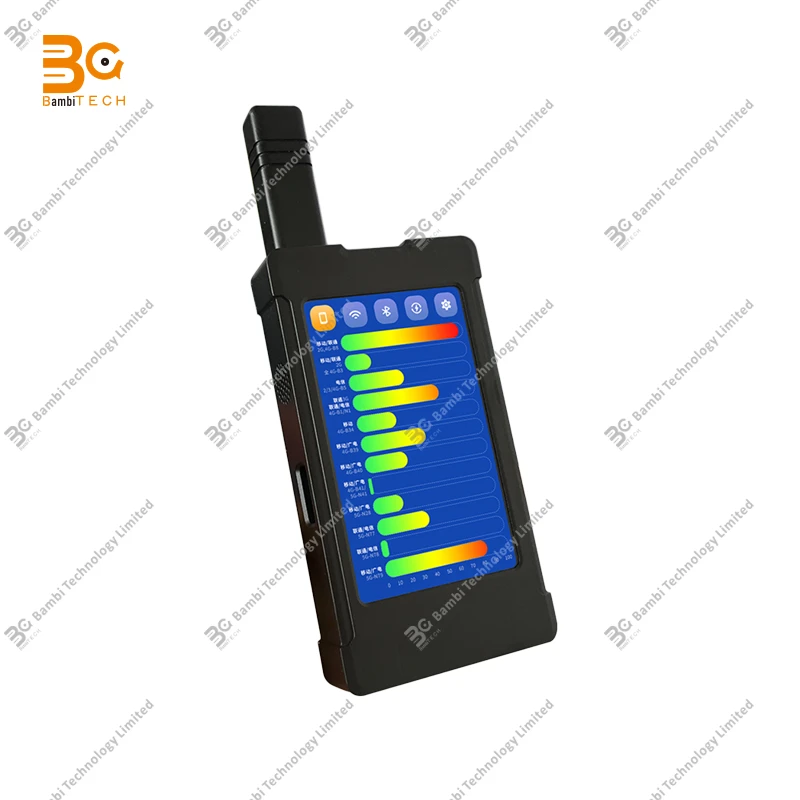
1.Radio frequency signal detector (wireless signal scanner) :
Principle: Scan wireless signals within a specific frequency range (such as Wi-Fi, Bluetooth, 2G/3G/4G/5G, and specific frequency bands for eavesdropping devices). An alarm is triggered when suspicious or abnormal wireless transmission sources (such as hidden eavesdropping devices, data transmission signals from secret cameras, or mobile phone hotspots) are detected.
Application: Quickly screen for wireless eavesdropping and secret filming devices in rooms and vehicles, and locate the signal source. It is a fundamental tool for on-site investigation of anti-eavesdropping and anti-eavesdropping.
2.Nonlinear Node Detector (NLJD):
Principle: Transmit radio frequency signals of a specific frequency to the target area. Any electronic device containing semiconductor components (such as bugging devices, pinhole cameras, unpowered mobile phones, and even SIM cards) will generate unique harmonic signals that are received and identified by detectors.
Application: It can detect electronic espionage devices that are turned off, in standby mode or have their batteries removed (as long as they contain semiconductor chips), and is good at discovering deeply hidden devices. It is a powerful tool for in-depth anti-eavesdropping checks.
3.Thermal imager (infrared thermal imager):
Principle: Detect infrared radiation (heat) on the surface of an object. Electronic devices in operation (such as eavesdropping devices, cameras, and mobile phones) generate heat significantly higher than the ambient temperature, which is clearly displayed on the thermal imager screen.
Application: Quickly scan large areas (such as ceilings, walls, and the interiors of large furniture), locate working heat sources (such as eavesdropping devices, malfunctioning routers, etc.), especially suitable for night or dark environments. It is an auxiliary means for on-site investigation of anti-eavesdropping.
Third, building a safety barrier: Choice and Action
Choose as needed: For personal and household daily protection, RF detectors and thermal imagers are economical and practical options. Enterprises or highly sensitive places should consider professional services or be equipped with high-end comprehensive facilities.
Regular inspection: Anti-eavesdropping and anti-eavesdropping are continuous tasks. Especially before important meetings, after moving into an unfamiliar environment, and when there is suspicion of information leakage, tests should be conducted.
Enhance awareness: Develop good safety habits, such as not connecting to unfamiliar Wi-Fi at will, regularly checking the safety of personal electronic devices, and paying attention to the safety of the physical environment.
Privacy and security are fundamental rights in the digital age. In the face of pervasive espionage technology, Chinese custom manufacturers take the initiative to act and make good use of professional anti-eavesdropping detection equipment, which is the core strategy for building a "shield of information protection" for individuals and enterprises. Only by understanding the threats, mastering the tools and taking proactive actions can one create a truly safe haven for oneself in this seemingly calm ocean of information, leaving no place for the "invisible eyes" and "invisible ears" to hide.