In emergency rescue operations, large-scale event support, or complex terrain work, traditional communication networks often experience disruptions in information transmission due to insufficient signal coverage or reliance on fixed base stations. The relay station self-organizing network equipment forms a dynamic network through autonomous connections of wireless nodes, enabling stable communication without the need for fixed base stations, making it a key technology for ensuring smooth information flow in emergency scenarios.
First, technical principle and core components:
The self-organizing relay station is composed of a wireless communication module, an intelligent routing algorithm and a high-capacity battery. It supports adaptive switching across multiple frequency bands. The core principle is that nodes automatically discover, negotiate and establish connections through wireless signals, forming a decentralized mesh network. When a certain node fails, the remaining nodes can automatically re-plan the path to ensure the continuity of data transmission. The built-in intelligent routing algorithm in the device can dynamically optimize the transmission path based on factors such as signal strength and node load, improving network stability.
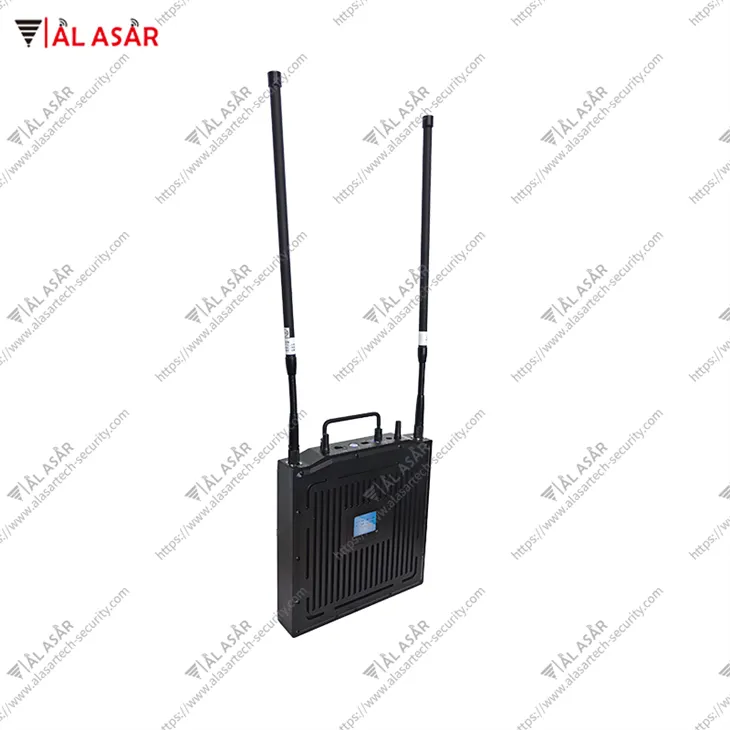
Second, typical application scenarios and advantages:
In earthquake rescue operations, traditional base stations may fail due to damaged infrastructure. Self-organizing network devices can be quickly deployed to form a temporary communication network, supporting voice dispatching, video transmission, and sharing of location information for rescue teams. Its advantages lie in three aspects:
1. Flexible deployment, no need for pre-planning of base station locations;
2. Strong resilience, a single node failure does not affect the overall network;
3. Strong scalability, coverage can be expanded by adding nodes. Compared to traditional relay stations, self-organizing network devices eliminate the need for manual configuration of routes, significantly improving emergency response efficiency.
Third, operation method and safety guidelines:
When using the device, follow the three-step process: Firstly, check the battery power and frequency band settings to ensure compatibility with surrounding devices; Secondly, activate the self-organizing network mode through physical buttons or the APP. The device will automatically search for and connect to nearby nodes; Finally, confirm the network topology through the signal strength indicator light or the management interface. In terms of security, the device supports AES encryption and dynamic key update to prevent data from being intercepted. It is important to avoid using the device in metal enclosed spaces or in environments with strong electromagnetic interference, as this may affect the signal transmission quality.
Fourth, technical parameters and performance:
The mainstream devices support dual-band operation at 2.4GHz/5GHz, with a maximum coverage radius of up to 5 kilometers (in an open environment). Each node can simultaneously connect up to 32 terminals. Through a stepped power adjustment technology, the device can dynamically adjust the transmission power between 100mW and 1W according to actual needs, balancing the coverage range and energy consumption. The measured data shows that in a network consisting of 20 nodes, the end-to-end delay can be controlled within 200ms, meeting the requirements for real-time voice communication. The device has passed IP67 protection certification and can operate stably in an environment ranging from -20℃ to 55℃.
We are a Chinese manufacturer specializing in custom-made mesh repeaters. We offer a variety of mesh repeaters for your selection or customization. If you have any requirements, please contact us at info@alasartech-security.com.