Have you ever seen the notice "Cellphone signal has been blocked" outside the examination room? Have you ever wondered why mobile phones suddenly "lost connection" in prisons, gas stations, or even certain meeting rooms? All of these are related to a mysterious small device - the cellphone signal jammer. It is like a "mute button" in the electromagnetic world, which can make cellphone signals disappear instantly within a specific area. Today, we will uncover its mysterious veil.
First, what is a mobile phone signal jammer?
A mobile phone signal jammer, also known as a signal blocker, shielding jammer or mobile phone signal disconnector, is an electronic device that can suppress or block the transmission of wireless signals within a specific range. It does this by emitting interference signals that are the same as or similar to the communication frequencies of mobile phones, preventing the target area's mobile phones from receiving or sending signals normally, thereby achieving the purpose of blocking communication.
In simple terms, the jammer creates an electromagnetic noise environment, preventing the mobile phone from hearing the call from the base station and also preventing it from being able to transmit its own signal.
Second, how does it work?
To understand the working principle of the jammer, one needs to first understand how mobile phones communicate. When a mobile phone is in operation, it connects to the base station within a certain frequency range through radio waves, and transmits data and sounds at a specific rate and modulation method.
The jammer precisely targets this communication principle and "cures the disease accordingly". Currently, the mainstream shielding technologies can be mainly classified into two categories:
Active interference (high-power suppression)
This is the most common shielding method. During operation, the interference device scans from the lower end to the higher end of the forward channel at a certain speed, emitting high-frequency electromagnetic waves that are the same or similar to the communication frequency of mobile phones. This scanning speed can create garbled interference in the mobile phone's reception of message signals, preventing the mobile phone from detecting the normal data sent from the base station. The connection between the mobile phone and the base station is cut off. Specifically, the interference signal increases the bit error rate of the mobile communication channel and reduces the signal-to-noise ratio. When the signal-to-noise ratio drops to a certain level, the mobile phone is unable to decode the broadcast information from the base station normally, and eventually manifests as being unable to find the network, having no signal, or being out of service area.
Passive shielding
Unlike active interference, passive shielding involves constructing physical barriers to block the propagation of electromagnetic waves. Common methods include metal shielding (using metal plates to reflect and absorb electromagnetic waves), conductive coatings (forming a conductive layer on the surface of buildings to reduce signal penetration), and electromagnetic absorption materials (converting radio energy into heat energy) etc. This approach is more like an invisible electromagnetic "wall".
Signaling-level intelligent shielding
This is a more advanced technology. The device scans the antenna to detect public network signals, and then simulates the signals of the public network base station to block the mobile phone, forcing the mobile phones in the area to connect to this device and thus preventing them from connecting to the public mobile communication network. The signaling-level jammer demodulates and decodes the synchronization, pilot, and control channels of the operator's network, re-frames and encodes the important channels of the operator's network, making it impossible for the mobile phone to establish normal synchronization and addressing with the operator's network.
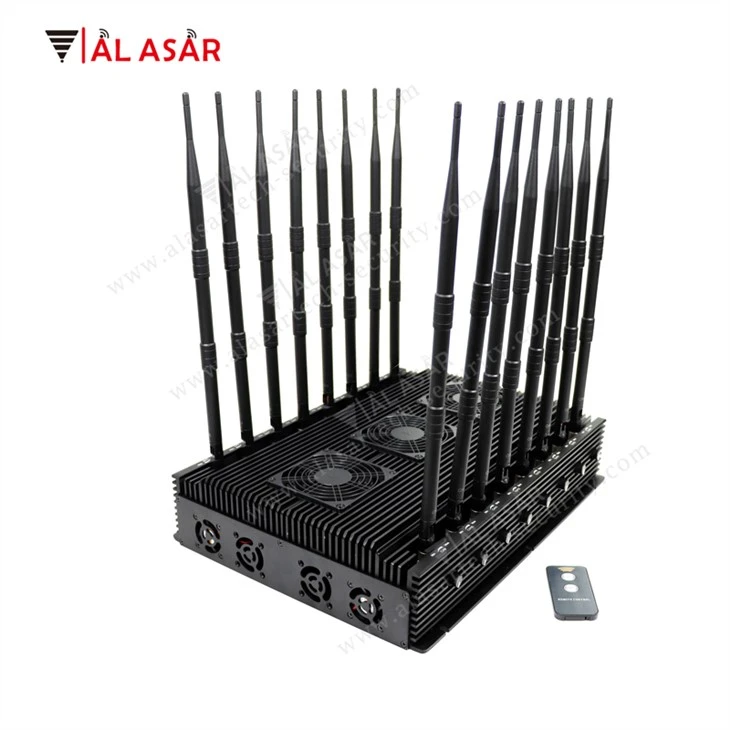
Third, what does an interference device look like?
A typical signal interference device usually consists of the following core components: an antenna for releasing interference signals, a radio frequency signal source (to generate interference signals that match the communication frequency of the target), an amplifier (to increase the output power of the interference signal to expand the coverage area), a control unit (responsible for the overall operation logic of the interference device), and a power supply module.
Depending on the usage scenario, interference devices can be roughly classified into three types: portable - small in size and light in weight, suitable for temporary security checks; fixed - installed in buildings, suitable for prisons, government agencies, etc. for long-term shielding needs; integrated - embedded in building walls or ceilings, combining aesthetics with functionality.
Fourth, where are the disruptors used?
The application scenarios of signal jamming devices are far more extensive than we might imagine. They mainly fall into the following areas:
Preventing cheating in exams: This is one of the most common applications of interference devices. During important exams such as the junior high school entrance exam, senior high school entrance exam, and graduate school entrance exam, signal interference devices are usually turned on in the examination rooms to prevent candidates from using mobile phones to cheat and to ensure the fairness and impartiality of the exams.
Prison security management: Prisons are places where criminals gather. Interference devices can block illegal communication links between prisoners and the outside world, preventing them from remotely committing crimes or planning escapes through mobile phones.
Gas stations and chemical plants: In these flammable and explosive areas, the weak electric sparks generated during mobile phone conversations may pose a safety hazard. Interference devices can effectively prevent accidents caused by the use of mobile phones.
Confidential meeting venue: In government offices, military facilities, financial and securities institutions, and confidential meeting rooms, the interference device can prevent eavesdropping via mobile phones or information leakage, ensuring the confidentiality of the meeting content.
Churches, concert halls, courts, etc.: These places require a quiet environment. Interference devices can prevent the disturbance caused by mobile phone ringtones, ensuring the solemn atmosphere of ceremonies or events.
Mobile signal jamming devices are an indispensable "double-edged sword" in modern society. In places where communication needs to be strictly controlled, such as examination rooms, prisons, and gas stations, they are powerful tools for maintaining fairness and ensuring safety. However, at the same time, their use must strictly comply with laws and regulations and no unauthorized settings are allowed.
We are a Chinese manufacturer specializing in custom signal jammer production. We offer a variety of signal jammers for your selection and customization. If you have any requirements, please contact us at info@alasartech-security.com.